


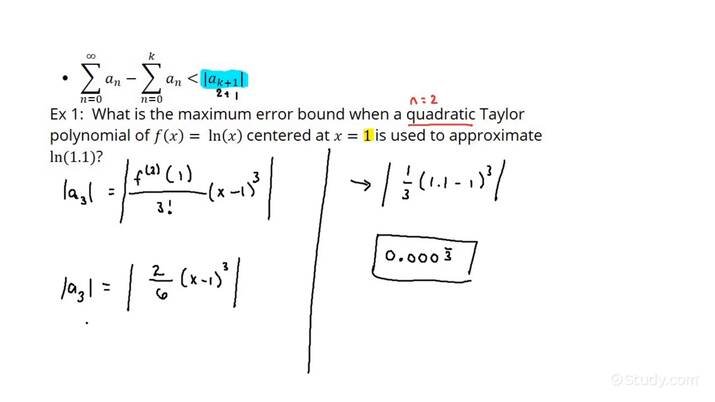
The alternating series error bound provides a crucial method for approximating the sum of alternating series and determining the accuracy of the estimation. By understanding this concept, we can confidently assess how close our computed sum is to the actual sum of the series. This error bound is essential in various mathematical and scientific applications where precise calculations are necessary. Let’s delve into the intricacies of the alternating series error bound to enhance our analytical skills and optimize our problem-solving strategies.

Exploring the Fascinating World of Alternating Series Error Bound
Welcome, young mathematicians! Today, we are going to delve into the intriguing concept of alternating series error bounds. Have you ever wondered how close the partial sum of an alternating series is to the actual sum? Well, that’s where the alternating series error bound comes into play! Let’s embark on this mathematical journey together and unravel the mysteries behind this fascinating topic.
The Basics of Alternating Series
Before we dive into the world of error bounds, let’s first understand what alternating series are. An alternating series is a series in which the signs of the terms alternate between positive and negative. It has a general form of:
$$S = a_0 – a_1 + a_2 – a_3 + \ldots$$
Each term in the series alternates in sign, creating a unique pattern that distinguishes it from other types of series. Now, let’s move on to the heart of our discussion – the error bound associated with alternating series.
Understanding Error Bound
When we talk about the error bound of an alternating series, we are essentially quantifying how close the partial sum of the series is to the actual sum. It provides us with a way to estimate the error or the difference between the partial sum and the infinite sum of the series.
The error bound can help us determine the precision of our calculations and understand the margin of error in approximating the total sum of an alternating series. This concept is crucial in various fields of mathematics and is used extensively in real-world applications.
Calculating the Error Bound
Now, let’s get into the nitty-gritty of calculating the error bound for an alternating series. The error bound is typically expressed in terms of the absolute value of the first neglected term in the series. This neglected term is the first term that is not included in the partial sum but contributes to the total sum.
The error bound formula for an alternating series can be represented as:
$$E_n = |a_{n+1}|$$
Here, $E_n$ represents the error bound for the nth partial sum of the series, and $a_{n+1}$ is the absolute value of the first neglected term.
Example: Calculating the Error Bound
Let’s consider an alternating series with the general form:
$$S = 1 – \frac{1}{2} + \frac{1}{3} – \frac{1}{4} + \ldots$$
If we want to find the error bound for the sum of the first 5 terms, we need to calculate the absolute value of the next term after the 5th term. In this case, the 6th term is $-\frac{1}{6}$. Therefore, the error bound for the sum of the first 5 terms would be $|\frac{1}{6}| = \frac{1}{6}$.
By understanding how to calculate the error bound, we can gain insights into the accuracy of our partial sum approximation and make informed decisions about the reliability of our results.
Applications of Error Bound
The concept of error bound plays a crucial role in various mathematical and scientific disciplines. It is used in numerical analysis, statistics, and engineering to estimate the accuracy of numerical methods and models. By understanding the error bound of an alternating series, mathematicians and scientists can make more precise calculations and draw reliable conclusions from their data.
Moreover, error bounds are essential in computer science and algorithm analysis. They help programmers evaluate the efficiency and correctness of algorithms, ensuring that computations are carried out with minimal errors and maximum efficiency.
Wrapping Up
Congratulations, young mathematicians! You have successfully delved into the world of alternating series error bounds and gained valuable insights into how they contribute to the accuracy of mathematical calculations. Remember, error bounds are your trusted companions in the realm of mathematics, guiding you towards precise results and reliable conclusions.
Keep exploring the wonders of mathematics, and don’t be afraid to embrace the complexities that come your way. With a curious mind and a passion for learning, you can conquer any mathematical challenge that comes your way.
Until next time, keep counting, calculating, and conquering the world of numbers!
Calculus BC – 10.10 Alternating Series Error Bound
Frequently Asked Questions
What is the Alternating Series Error Bound theorem?
The Alternating Series Error Bound theorem provides a way to estimate the error when approximating a convergent alternating series with a partial sum. It gives a bound on how far off this partial sum can be from the actual sum of the series.
How is the error bound calculated for an alternating series?
To calculate the error bound for an alternating series, you need to find the absolute value of the next term in the series after the last term included in the partial sum. This absolute value represents the maximum possible error in the partial sum.
Why is the Alternating Series Error Bound theorem helpful in mathematics?
The Alternating Series Error Bound theorem is valuable in mathematics as it allows mathematicians to quantify the accuracy of approximating a convergent alternating series. By providing an upper limit on the error, it helps ensure that the partial sum is sufficiently close to the true sum.
Can the Alternating Series Error Bound theorem be used to determine convergence of alternating series?
No, the Alternating Series Error Bound theorem does not determine convergence of alternating series. It specifically focuses on estimating the error in the partial sum approximation and does not provide information about the convergence or divergence of the series itself.
How can the error bound obtained from the theorem be used in practice?
The error bound obtained from the Alternating Series Error Bound theorem can be used to guarantee a certain level of accuracy in practical calculations that involve convergent alternating series. It helps in assessing the reliability of the partial sum as an approximation of the true sum.
Final Thoughts
In conclusion, the alternating series error bound provides a crucial way to estimate the error when using alternating series to approximate a sum. By understanding and applying the error bound formula, we can have a reliable indication of the accuracy of our approximation. Remember that the error bound depends on the value of the first neglected term in the series. Therefore, being mindful of this bound can help us make informed decisions when using alternating series in mathematical calculations.